Author David Ashley White
Foreword by Richard Leach
Released July 2003
Catalog no. 125-027 (paperback, 52pp.)
Price $12.50 (U.S.)Read the introduction
Order now!


 Download the indexes Download the indexes
Tunes/Texts included
- ABBESS OF WHITBY "God, You Glory Fills the Earth" (Richard Leach); named for for Hilda (614–680), who lived in Whitby, a town in Yorkshire, on the northeast coast of England
- BRECKENRIDGE "My God, How Many Wonders You Have Done" (Richard Leach); named for the town in Texas where an anthem based on this hymn was premiered, a commission by the town’s First Christian Church
- COMMONWEALTH "Small Is the Table" (Richard Leach); named for Commonwealth Avenue in Boston; composed during D.A.W.’s trip to the Hymn Society’s 2000 conference, which was held in that city; the music came first — Richard Leach later wrote the text to fit the music
- CUMBERLAND "I Praise You, God" (Psalm 30, para. Richard Leach)
- DOVE OF PEACE "We Who Wake in Hope Each Morning" (Fred Pratt Green, Richard Leach); name given to the text by the author of the first stanza, Fred Pratt Green
- ELIZABETH ROSE "Lord, You Have Blessed Us" (Rae E. Whitney); named for the daughter of David and Virginia Schaap and the godchild of Al and Sue Fedak and D.A.W.; commissioned for, and premiered at, Eliza’s baptism at St. John’s Church, Kingston, New York
- FORTY ACRES "Good Shepherd, You Know Us" (Christopher Idle); name associated with The University of Texas at Austin, which originally consisted of forty acres of land; commissioned by The Church of the Good Shepherd, Austin, part of a project of commissioned hymn texts and tunes devoted to the theme of the Good Shepherd
- HOUSE OF BREAD "House of Bread, Manger Bed" (Patricia Clark); name from the text
- JANET "Conceived in the Autumn" (Rae E. Whitney); named for Janet Clark White, D.A.W.’s sister-in-law
- LIVING STRING "A Harp Too Great" (Richard Leach); name from the text; commissioned by the Fellowship of United Methodists in Music and Worship Arts, for performance at its 1997 national conference held in Houston
- LOVE'S DOOR "Above Love’s Door" (Richard Leach); name from the text; commissioned for a premiere at the wedding of Anna Thomas and Michael Brozick, 24 June 2000
- LUCILE "Since We By Sin Have Lost Our God" (Richard Leach); named for Lucile Birmingham Melcher, friend of D.A.W. and a supporter of the Moores School of Music at the University of Houston
- LYNN "So Near, We Cannot See You" (Richard Leach); named for Lynn Lamkin, friend and colleague of D.A.W.
- NEW BEGINNINGS "This Is a Day of New Beginnings" (Brian Wren); name from the text; this hymn served as the basis for an anthem commissioned by Bering United Methodist Church, Houston, in celebration of its sesquicentennial in 1998
- NEW HARMONY "O God, You Sang Creation into Being" (Patricia Clark); named for the village in Indiana; dedicated to Jane Blaffer Owen and the late Kenneth Dale Owen
- OLD PLUM GROVE "I Give Myself to You" (Rae E. Whitney); named for an old community near LaGrange, Texas, home to some of D.A.W.’s ancestors
- PRAISE THE SPIRIT "Praise the Spirit" (Patricia Clark); name from the text
- ST. ANDREW BY THE SEA "O Christ, We Sing the Shoreline" (Richard Leach); named for the church in Gulf Shores, Alabama; commissioned in honor of Curt and Myra Branyon, who helped found the church, by their daughter and son-in-law, Linda and Brad Harmes
- ST. BARTHOLOMEW THE GREAT "To Thee, O Comforter Divine" (F. Havergal, 1872); named for the ancient parish church in London; composed in the church’s crypt during Holy Week 1998
- ST. PAUL'S CHOIR "Sing Praise to Our Creator" (Omer Westendorf); named in honor of the choir of St. Paul’s United Methodist Church, Houston
- SANDRA “Why Has God Forsaken Me?” (Bill Wallace); named for Sandra Burns, D.A.W.’s good friend
- SOUTHWARK CATHEDRAL "The Paschal Moonlight Almost Past" (John Mason Neale, 1866); named for the London cathedral where this hymn was premiered during the 1997 conference of the Association of Anglican Musicians
- TAYLOR "Heal Me, Hands of Jesus" (Michael Perry); named for Walter Taylor, former dean of Christ Church Cathedral, Houston
- TIMBERGROVE "Filled with the Spirit’s Power" (J.R. Peacey); named for the neighborhood in Houston where D.A.W. lives
- TRAVIS PARK "Listen, You Lovers of Lore and of Legend" (Richard Leach); named for San Antonio’s Travis Park United Methodist Church, where D.A.W. composed this hymn while attending a music convention in that city in February 2002
- WALES "Are You Weary of Your Burden?" (John Mason Neale, adapt. Richard Leach); named for Suzanne and Kenneth Wales, patrons of D.A.W.
- WEBER "The Life Laid Down" (Carl P. Daw, Jr.); named for Betsy, Rick, and Emily, friends of D.A.W.
- WILDRIDGE and ST. CHARLES, QUEENSBOROUGH TERRACE "So the Day Dawn for Me" (Timothy Dudley-Smith); named for Peter Wildridge and the hotel he owned in the Bayswater section of London
- WONDROUS MAJESTY "On Wings of Wondrous Majesty" (Herbert O’Driscoll); name from the text
|
Review
"Overall, [White's] harmonic language is logical, interesting, and effective...I think that this volume of hymns is well worth the price and may yield great personal benefit to all who use it." --The Hymn, Winter 2006
Description
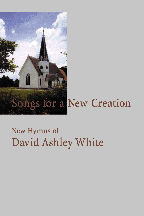
Songs for a New Creation is a new collection of hymns by the well-known composer David Ashley White, whose sacred and secular compositions are widely performed and published. His hymns appear in a number of books, including The Hymnal 1982 and its supplement, Wonder, Love, and Praise; and The United Methodist Hymnal and its recent supplement, The Faith We Sing. In 1996 his first collection of hymns, Sing, My Soul, was published by Selah.
Songs for a New Creation reflects a variety of styles: some of the hymns are in parts, while others are in unison. Hymns in "cathedral style" are found next to those that were influenced by American folk tunes. But all are eminently singable and memorable, and will provide your congregation new means to sing God's praise.
White's fine sense of melodic line, harmony, and rhythm is found in these hymns, as is his gift of choosing wonderful texts. In this volume you will find work by Patricia Clark, Carl P. Daw, Jr., Timothy Dudley-Smith, Fred Pratt Green, Christopher Idle, Richard Leach, Herbert O'Driscoll, J.R. Peacey, Michael Perry, Bill Wallace, Omer Westendorf, Rae E. Whitney, and Brian Wren. These 29 hymns cover the church year and all times of worship.
David Ashley White is Director of the Moores School of Music at the University of Houston and is also Professor of Composition and Theory.
Foreword
David Ashley White is a musical craftsman, an artist, a master hymn composer. Though I don't know how composing feels to him, I envision him working calmly but fairly swiftly, with assurance, as he uses the tools of imagination, training and experience to shape and join the materials of melody, harmony, rhythm and text together into things of beauty. An unusual angle in the words? David will take care of it. The music will fit, the seams won't show.
From one perspective, the items David makes when he composes hymns are small. A complete hymn may be only eight measures of music; hymn scores often fit easily onto a single page. Yet hymn settings are also capacious, because when we sing them they hold our feelings, and they provide room in which many singing people can be together.
Beauty is self-justifying, it is always partly for its own sake. But the beauty of David's hymn settings is also practical. It is there so that people can sing, so the church can sing to God.
David composes with exemplary sensitivity to the texts he sets. And if I may say so, he has good taste in choosing them. He looks for solid craft to which he may apply his own, and for striking images which are not trendy, but will continue to speak as time goes by.
David's scope as a musician is much wider than hymns. I am personally grateful that he cares about setting hymn poetry, and I believe that many churches and many singers should be as well. It is my pleasure to welcome you into this second collection of his hymn settings.
--Richard Leach
Torrington, Connecticut, May 16, 2002
Introduction
It has been six years since the publication of my first collection of hymns, Sing, My Soul. Those 69 compositions-in-miniature were composed over a span of almost twenty years. As I wrote in the preface of that book, composing hymns involves "a distillation of ideas, a crystallization of elements to their purest form." Such small works, like short poetry, always present many challenges-challenges that fortunately yield great musical rewards.
With two exceptions, the 29 hymns contained in Songs for a New Creation were composed after the publication of Sing, My Soul and reflect a variety of styles. Some are in parts, while others are in unison. Hymns in "cathedral style" are found next to those that were influenced by American folk tunes. (A setting of an actual Carolina folk melody is also included in this volume, under the tune name NEW HARMONY.)
The musical styles that I employ throughout the book are undeniably influenced by the texts. Because I typically allow the flow of words to affect the rhythm and meter of the music, rhythmic variety and metrical changes are often the norm. In addition, the architecture of the words usually affects the shape of the music, in terms of both melody and harmony.
I cannot overestimate the importance of finding good hymn texts. I look for words that are theologically sound and timeless in their message, expressed through imaginative and beautiful use of language.
Collaborating with many of today's finest writers remains a joy for me. Songs for a New Creation contains the work of 15 writers, and all but two--John Mason Neale and Frances Ridley Havergal--have played pivotal roles in today's hymn explosion. It is a pleasure to continue to collaborate with Rae Whitney and to have begun to work with Patricia Clark, a fellow Texan from Austin. Also, I am pleased to have included a setting of a new text by Carl P. Daw, Jr. My work with Carl goes back many years. I appreciate his support and have always admired his talent.
I am particularly indebted to my good friend and colleague Richard Leach, with whom I have worked closely over the past six years. His contributions to this book are notable for their well-conceived content and their great attention to detail. Richard's inventive metrical choices challenge and stretch my compositional process.
Some of the hymns found in this book were commissioned. To those people who were the catalysts for such creation, I express my gratitude. I am also grateful to the many church musicians who have regularly scheduled my hymns for performance -they keep my music alive.
There are individuals whose personal encouragement made my work easier and more meaningful, particularly Andy Achenbaum, for whom I worked for the past three years, and Alan Austin, my friend. I should also give special mention to Jake and Benjie - they heard every note of these hymns as they were composed.
Finally, I want to thank David Schaap, my publisher. David has emerged as a leader of hymn publishing in the United States and works to support a number of writers and composers who are drawn to this important genre of sacred art.
--David Ashley White
Houston, Texas, 24 June 2002
|
|
|
|
|
|
|